Technical Guides
Honeycomb Panels for Furniture: Weight Savings Without Losing Stiffness
Aluminium honeycomb panels cut furniture weight by up to 80% while staying flatter than solid sheet — where they work, where they do not, and what to specify.
A two-metre reception counter built from solid aluminium plate weighs more than the people leaning on it. Built on an aluminium honeycomb panel, it weighs a fraction — and stays flatter over its lifetime. For furniture fabricators and fit-out contractors, honeycomb is the difference between designs that ship economically and designs that need two installers and a forklift.
How the Panel Works
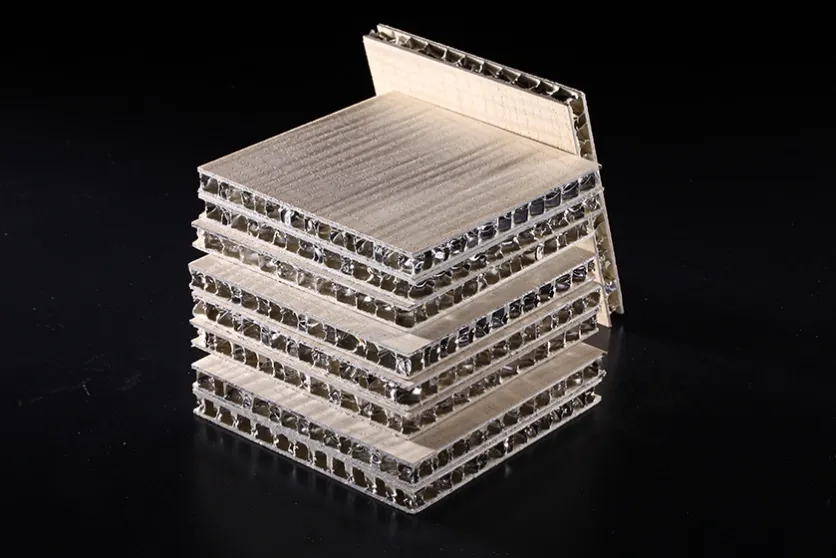
An aluminium honeycomb panel sandwiches a hexagonal aluminium core between two thin aluminium faces. The structure borrows its stiffness from geometry, not thickness: a 10 mm honeycomb panel can be stiffer than 3 mm solid sheet at roughly a fifth of the weight.
The practical numbers:
- A 10 mm honeycomb panel weighs around 5–7 kg/m²; equivalent stiffness in solid 3 mm sheet weighs 8+ kg/m² — and sags over time.
- Large formats stay achievable: 2400 × 1200 mm panels are standard, with larger sizes available per project.
- The panel is anisotropic — strong across the faces, weaker at the edges — which shapes every detailing decision below.
Where Honeycomb Wins in Furniture
Counters and reception desks. Large panels, visible flatness, and dead weight all argue for honeycomb. The panel holds a mirror-flat face across two metres without visible oil-canning.
Wall-mounted furniture. Floating vanities, shelves and headboards live or die on fixing loads. Honeycomb cuts the panel weight so the substrate does less work.
Mobile and modular pieces. Display units that travel between locations survive transport better when the panels do not flex in the van.
Where It Does Not
Structural parts. The core has almost no strength through its thickness. Any panel that carries loads through its edge — a shelf spanning between side panels, a leg, a hinge line — needs solid aluminium inserts bonded at the edge, which must be specified in advance.
Exposed edges. A cut honeycomb edge shows an open core. Every visible edge needs a trim profile, folded return, or bonded solid edge strip. Design the edges, do not leave them to the workshop.
Fixing points. Screws into the face grip only the thin skin. Fixing requires inserts, bonded bosses, or through-bolts with backing plates — tell the fabricator where every fixing lands before production.
What to Specify
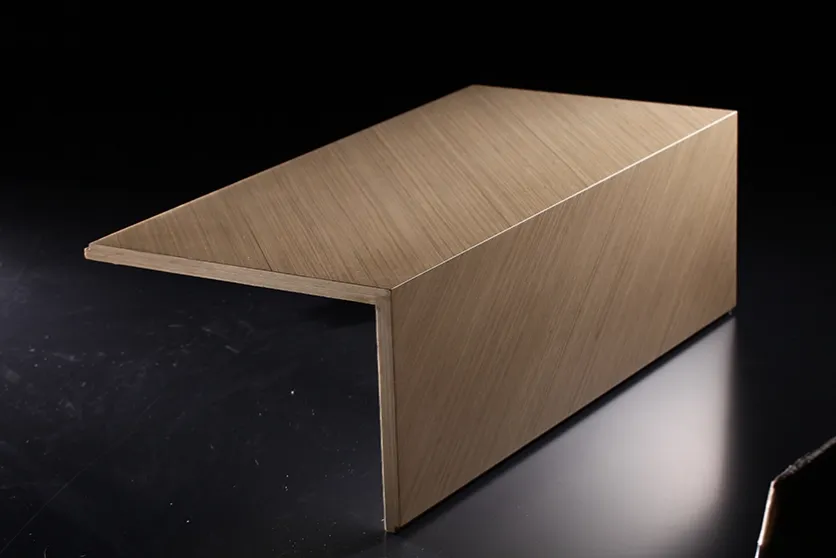
Four items cover most of it: total panel thickness (10–25 mm typical), skin thickness (0.8–1.2 mm for furniture), edge treatment per side, and the position of any inserts or fixing plates. Add the surface finish — honeycomb panels accept the same powder coats and wood-grain veneers as solid sheet, so the visual specification does not change.
The Bottom Line
Honeycomb does not replace solid aluminium; it replaces solid aluminium in the places where weight buys nothing and flatness buys everything. Counters, wall panels, doors and large cladding elements are exactly those places. Send your furniture drawings with panel sizes and fixing points, and the panel schedule can be engineered before anything is cut.